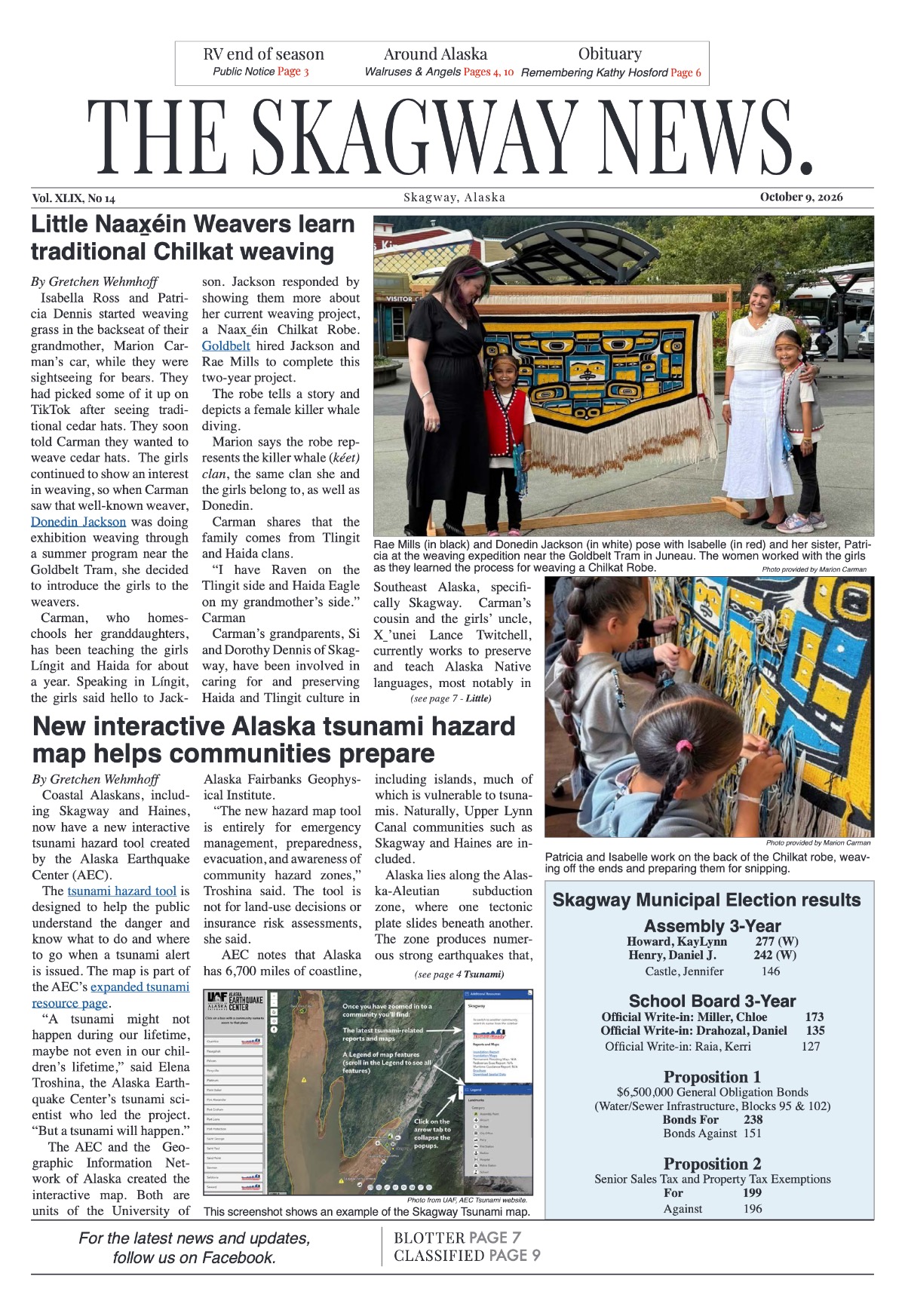
The words in this issue
Page 1
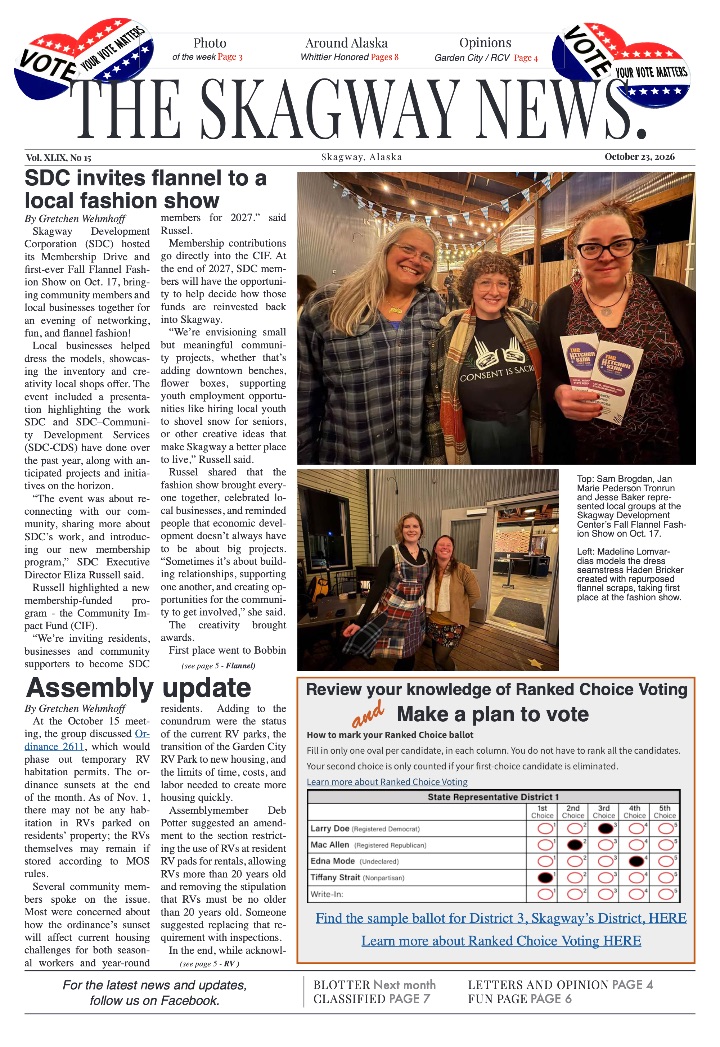
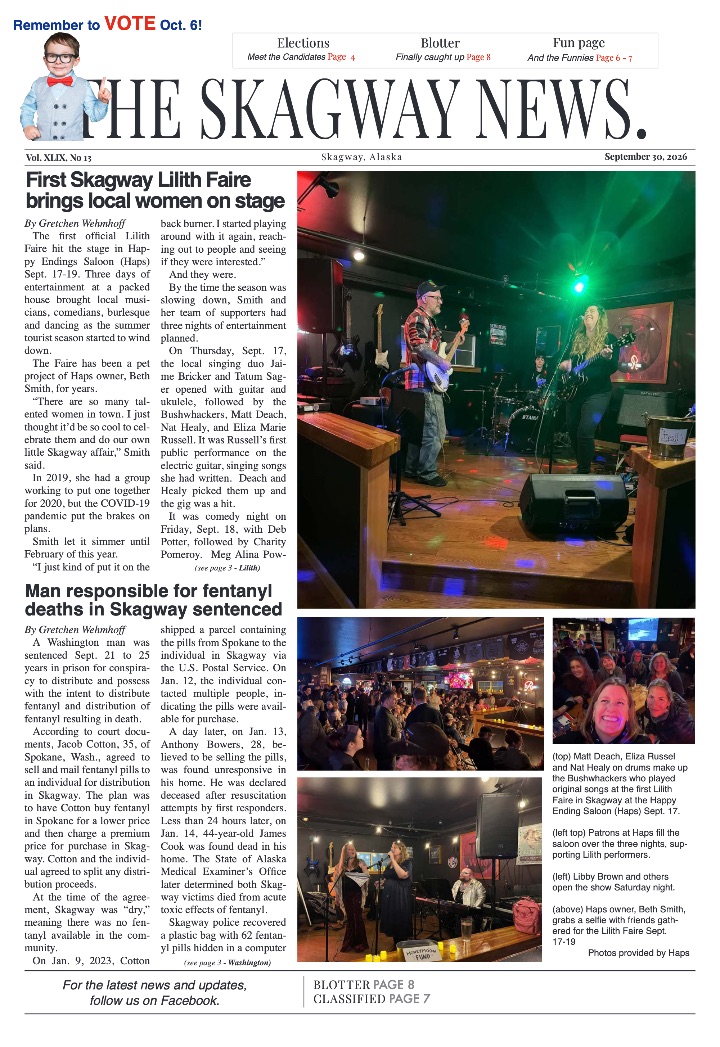
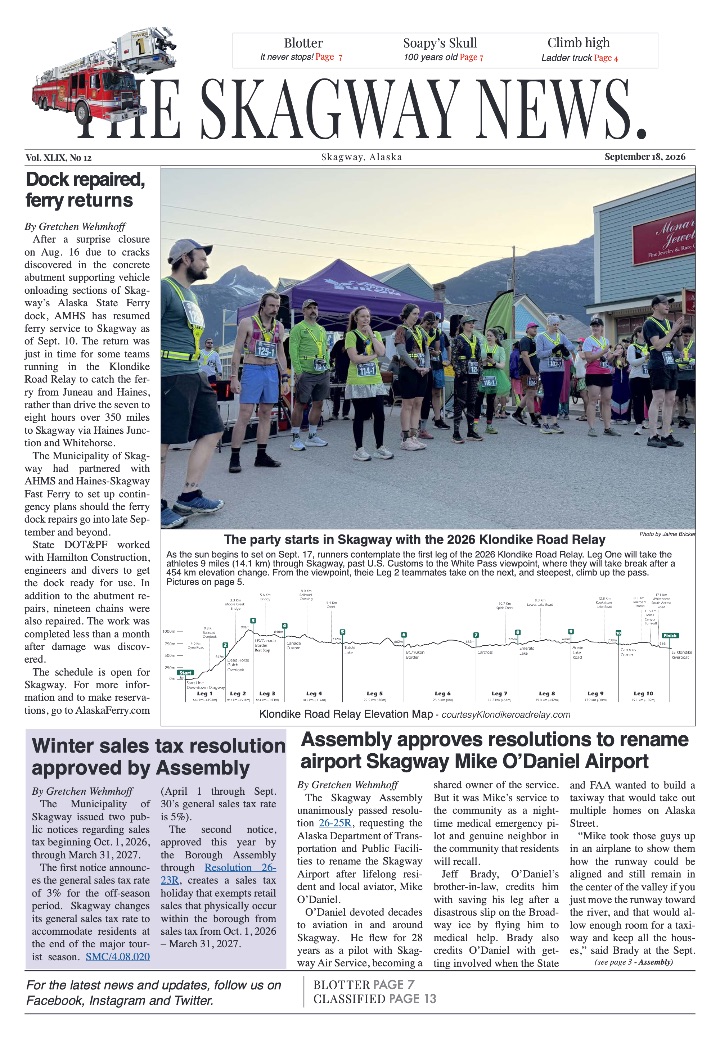
THE SKAGWAY NEWS.
Sk a g w ay, A l a s k aOctober 9, 2026
For the latest news and updates, follow us on Facebook. BLOTTERPAGE 7 CLASSIFIEDPAGE 9
Vol. XLIX, No 14
Public NoticePage 3Remembering Kathy HosfordPage 6
Walruses & AngelsPages 4, 10
RV end of seasonAround AlaskaObituary
(see page 7 -Little)
New interactive Alaska tsunami hazard map helps communities prepare
Photo from UAF, AEC Tsunami website. This screenshot shows an example of the Skagway Tsunami map.
By Gretchen Wehmhoff Coastal Alaskans, includingSkagwayandHaines, now have a new interactive tsunami hazard tool created bytheAlaskaEarthquake Center (AEC). Thetsunami hazard toolis designed to help the public understand the danger and know what to do and where to go when a tsunami alert is issued. The map is part of the AEC’sexpanded tsunami resource page. “Atsunamimightnot happen during our lifetime, maybe not even in our children’s lifetime,” said Elena Troshina, the Alaska Earthquake Center’s tsunami scientist who led the project. “But a tsunami will happen.” The AEC and theGeographicInformationNetwork of Alaska created the interactivemap.Bothare unitsoftheUniversityof
Alaska Fairbanks Geophysical Institute. “The new hazard map tool isentirelyforemergency management,preparedness, evacuation, and awareness of communityhazardzones,” Troshina said. The tool is not for land-use decisions or insurance risk assessments, she said. AECnotesthat Alaska has 6,700 miles of coastline,
including islands, much of which is vulnerable to tsunamis. Naturally, Upper Lynn Canal communities such as Skagway and Haines are included. Alaska lies along the Alaska-Aleutiansubduction zone,whereonetectonic plate slides beneath another. The zone produces numerous strong earthquakes that, (see page 4Tsunami)
Rae Mills (in black) and Donedin Jackson (in white) pose with Isabelle (in red) and her sister, Patricia at the weaving expedition near the Goldbelt Tram in Juneau. The women worked with the girls as they learned the process for weaving a Chilkat Robe.
By Gretchen Wehmhoff IsabellaRossandPatricia Dennis started weaving grass in the backseat of their grandmother,MarionCarman’s car, while they were sightseeing for bears. They had picked some of it up on TikTokafterseeingtraditional cedar hats. They soon told Carman they wanted to weave cedar hats.The girls continued to show an interest in weaving, so when Carman saw that well-known weaver, Donedin Jacksonwas doing exhibition weaving through a summer program near the Goldbelt Tram, she decided to introduce the girls to the weavers. Carman,whohomeschools her granddaughters, has been teaching the girls Língit and Haida for about a year. Speaking in Língit, the girls said hello to Jackson. Jackson responded by showingthemmoreabout her current weaving project, aNaax̲éinChilkatRobe. Goldbelthired Jackson and Rae Mills to complete this two-year project. The robe tells a story and depicts a female killer whale diving. Marion says the robe represents the killer whale (kéet) clan, the same clan she and the girls belong to, as well as Donedin. Carmansharesthatthe family comes from Tlingit and Haida clans. “IhaveRavenonthe Tlingit side and Haida Eagle on my grandmother’s side.” Carman Carman’s grandparents, Si and Dorothy Dennis of Skagway, have been involved in caringforandpreserving Haida and Tlingit culture in
SoutheastAlaska,specificallySkagway.Carman’s cousin and the girls’ uncle, X̱’uneiLanceTwitchell, currently works to preserve andteachAlaskaNative languages, most notably in
Photo provided by Marion Carman
Photo provided by Marion Carman
Patricia and Isabelle work on the back of the Chilkat robe, weaving off the ends and preparing them for snipping.
Skagway Municipal Election results Assembly 3-Year Howard, KayLynn277(W) Henry, Daniel J.242 (W) Castle, Jennifer146
School Board 3-Year Official Write-in: Miller, Chloe173 Official Write-in: Drahozal, Daniel135 Official Write-in: Raia, Kerri127
Proposition 1 $6,500,000 General Obligation Bonds (Water/Sewer Infrastructure, Blocks 95 & 102) Bonds For238 Bonds Against151
Proposition 2 Senior Sales Tax and Property Tax Exemptions For199 Against196
Little Naax̲éin Weavers learn traditional Chilkat weaving
Page 2
Page 2THE SKAGWAY NEWSOctober 9, 2026
The Skagway News. Skagway’s First Newspaper Christened in 1897, buried alive in 1904 and resurrected in 1978, The Skagway News is currently celebrating 49 years of reporting in Skagway and Dyea, Alaska, recording our Centennial years and beyond.
Subscriptions Sign up online at www.skagwaynews.com Online Only or leave a message at 907-983-2354 Mailing address: The Skagway News PO Box 672395, Chugiak, AK 99567
All subscriptions are online only. New rates will begin Dec. 1. Currently The Skagway News is free to the public as issues with past subscriptions are settled.
USPS 697130 ISSN 0745-872X Periodicals postage paid at Skagway, Alaska 99840 and additional mailing offices. POSTMASTER send address changes to: The Skagway News PO Box 672395, Chugiak, AK 99567
Vol. XLIX, No 14 (1018) October 9, 2026
Published online twice a month
Phone: (907) 983-2354 www.skagwaynews.com
Publisher Gretchen Wehmhoff
Contributors
Marion Carmon Kari Rain Skagway PD Alaska Air National Guard Seward Sealife Center Our wonderful advertisers and sponsors
Editor Emeritus William J. “Jeff” Brady
ADVERTISING & NEWS COPY DEADLINES Next issue will be published OCT. 23, 2026 Please email [email protected] All ads and classifieds by Oct. 20 COPY, LETTERS, CALENDAR DEADLINE: Please email [email protected] All news copy, letters and calendar events by Oct. 20, 2026
TheSkagwayNewswelcomesopinionspiecesand letterstotheeditor.Opinion pieces should be no longer than600 words and will be published based on space availabilityandrelevanceto current and local events. Letters to the editor should not exceed 250 words. Submitlettersandopinions to editor@skagwaynews. com. Letters may be edited for grammar and length.
Submissions
Opinion & Letters
Friday, Oct. 9 School: End of Quarter One Midterm of Semester One Tuesday, Oct. 13 Rec.Center: Senior Murder Mystery Party 1 - 4 p.m.
Recreation Board 5:30 Assembly Chambers (?)
School: First day of 3-year-old Pre-school
School: DDF - Sitka Tournament
Wednesday, Oct. 14 Library: Story Time 11 - 11:30 a.m.
Finance Committee 5 p.m. Assembly Chambers
School: Special Meeting 7 p.m.
Thursday, Oct. 15 KLGO Construction ExpecttrafficrestrictionsOct.15-Nov.23 NearslideCemeteryandLostLaketrailhead Borough Assembly Regular Meeting 7 p.m. Assembly Chambers
Friday, Oct. 16 School:Inservice-NoSchool School: HS Wrestling to Haines Monday, Oct. 19 School:AlaskaDay-NoSchool Tuesday, Oct. 20 School: Early Dismissal - 2:15 p.m. Clinic Finance Committee 6 p.m.
Clinic Planning Committee 7 p.m.
Thursday, Oct. 21 Volleyball Seeding Tournament- Craig Library: Story Time 11 - 11:30 a.m.
Saturday, Oct. 24 Rec Ctr: Senior Pumpkin Painting 11:30 a.m.
Rec Ctr: Spooky Skage Party, 7-9 p.m. - All Invited
Sunday, Oct. 25 Honor Fest - Haines Thursday, Oct. 29 School: Early Dismissal - 2:15 p.m. Monday, Nov. 2 School:Inservice-Noschoolforstudents
Meetings and Events
Send your Calendar events to:
[email protected] subject line calendar
The League of Women Voters of Alaska (LWVAK) is a non-partisan, grassroots, statewide volunteer organization. Our mission is: Empowering Voters, Defending Democracy. We never support or oppose political candidates, but we do take positions on statewide issues, including ballot initiatives, after extensive research and analysis. We are in strong support of Alaska1s current election law, which includes a nonpartisan open primary, dark money disclosure rules and ranked choice voting. This law was approved by voters in 2020 and re-affirmed by the electorate in 2024. LWVAK supports Alaska’s election process because we view it as a more inclusive, representative, and functional democratic system than party-controlled elections. Here are specific reasons why: An open primary With 63% of Alaska voters not registered with a political party, an open primary where we select any candidate of our choice just makes sense. Without an open primary, political party control will return, with each party again establishing the rules for who may participate. This means that parties control who is on the primary ballot and whether you need to be registered as a member to vote in their primary. Ballot Measure 2 also states that candidates for Governor and Lieutenant Governor would again run separately rather than as a ticket in the party primaries. Dark money disclosure “Dark money” is money spent to influence an election when voters cannot see who originally provided the funding. Alaska’s 2020 law added a “true source” requirement so that funding could be traced back to whoever actually paid for it. Ballot Measure 2 repeals that requirement. This is particularly important with spending from Independent Expenditure (IE) groups, allowed to proliferate after the 2010 U.S. Supreme Court Citizens United decision. Without Alaska’s dark money disclosure rules, we wouldn’t be able to see who is actually funding contributions to IE groups. It also eliminates the paid-for-by disclaimers on broadcast and digital advertising, drops the disclosure requirement for contributions over $2,000 a year, and removes fines for certain disclosure violations. Ranked choice voting (RCV) RCV provides the voter with choice the choice of ranking candidates in order of preference or not ranking if that is their preference. The system ultimately ensures broader support for the winning candidate. RCV ensures that the winner has majority support (50% +1), rather than just a plurality (the most votes in a particular race). Alaska’s current election system increases representation and reduces polarization. Candidates/elected officials work to communicate with a broader swath of constituents as opposed to only those with a particular political affiliation. This reduced polarization greatly impacts how candidates work with their peers once elected. For all of the above reasons, the League of Women Voters of Alaska urges Alaska voters to voteNOon Ballot Measure 2 on the 2026 general election ballot.
Marianne Mills Sarah-Moore Co-Presidents League of Women Voters of Alaska
Vote NO on Ballot Measure 2
The Skagway News welcomes opinions pieces and letters to the editor. Opinion pieces should be no longer than600 words and will be published based on space availability and relevance to current and local events. Letters to the editor should not exceed 250 words. Submit letters and opinions to [email protected]. Letters may be edited for grammar and length.
Page 3
Page 3
THE SKAGWAY N EWSOctober 9, 2026
Winter Hours:12:30-4:30 Mon-Sat 907-983-3354• www.skagwaybooks.com
SKAGUAYNEWSDEPOT &BOOKS CELEBRATE ALASKA BOOK WEEK Oct. 4-9 ••••• The Lingít People, Culture, and History by X’unei Lance Twitchell
Be Bear Aware The Skagway Police Department is warning residents that bear activity has been reported within Skagway city limits. They suggest everyone be alert, especially at night when bears are most active. Never leave trash or other bear attractants outside; securing them helps reduce bear activity and the risk that a bear may need to be dispatched. If you see a bear or signs of one, contact SPD at 907-983-2232
Things you should know
VisitorsandresidentstravelingDyea Flats Road should expect traffic restrictions and temporary road closures from Oct. 15 through Nov. 23 while crews replace culverts and repair the road near the Slide Cemetery and Lost Lake Trailhead turnoff in Klondike Gold Rush National Historical Park. The National Park Service says the work will improve drainage and help reduce the risk of future road washouts during extreme flooding. Traffic impacts will range from single-lane travel with flaggers to multi-day closures to through traffic. Anticipated road restrictions Oct. 15-23:Dyea Flats Road will remain open to single-lane traffic. Flaggers will direct vehicles through the construction area. Motorists should expect delays. Oct. 24-Nov. 17:The road will close to through traffic for two separate periods while crews install two culverts. Crews expect the first closure to last five to seven days while they install a smaller culvert south of Slide Cemetery Road. A second closure is expected to last 10 to 12 days while crews install a larger culvert east of Slide Cemetery Road. The road is expected to reopen for at least three days between the two closures. Exact closure dates will be announced as construction progresses. Nov. 18-23:Dyea Flats Road will return
to single-lane traffic, with flaggers directing vehicles through the construction area. Motorists should expect delays. The schedule is subject to change based on weather, construction progress and site conditions. Access during road closures Local property owners will receive permits to park a limited number of vehicles in designated areas on either side of the construction zone. During full road closures, a temporary pedestrian crossing will provide property owners access through the construction area. Members of the public may park at the Chilkoot Trailhead and access the historic Dyea townsite, Slide Cemetery and Dyea Flats on foot. Visitors should remain outside the active construction area and follow all posted signs and directions from construction personnel. The National Park Service will provide updated closure dates and road conditions as construction progresses. Current information will be available on theKlondike Gold Rush National Historical Park Alerts and Conditionswebpage and through KHNS and Skagway Police Department Nixle notifications. For current road conditions or questions about access, [email protected].
Public Notice regarding temporary habitation of recreational vehicles
Dyea road construction by Klondike Gold Rush National Historic Park
The Municipality of Skagway Permitting Office has issued the following public notice: At the end of use for the 2026 season, no later than November1st,allsewerlinesmustbeproperly cappedtopreventinflow and infiltration (I&I) into the collection system during the winter months. Additionally,Resolution No. 24-22R providing temporary annual permits allowing for the habitation of recreational vehicles will sunset on November 1, 2026.To date, no replacement legislation has been adopted. Upon terminationofResolution No. 24-22R, the temporary provisions will cease to apply,andSMC15.15will govern in accordance with its existing terms. Please review the following for potential updates and timeline: The Planning and Zoning Commission held a public hearingonSeptember10, 2026, and recommended to the Assembly adoption of an
ordinance establishing an attritional permit program for the temporary habitation of recreational vehicles. Theproposedordinance offers a transitional period for the gradual discontinuation of permitted RV habitation on private lots with an absolute end date of October 31, 2032.
The Assemblywillconduct the first reading of the ordinanceattheOctober 15th meeting. Follow-up notice will be senttoRVparkowners/ managers and permit holders (previous and current).
VOTE • NOV 3 • Improving economic stability and opportunity • Supporting our teachers and students • Restoring ferry service and infrastructure • Bringing back pensions for hardworking public employees • Protecting our neighbors from natural disasters
Paid for by Andi Story for House, 12069 Cross Street, Juneau, AK, 99801
andistoryforhouse.com Fo r H o u s e D i s t r i c t 3
Re-elect
Page 4
Page 4THE SKAGWAY NEWSOctober 9, 2026
depending on their location and characteristics, can generate tsunamis. Landslides, includingthoseoccurring beneath the ocean surface, can also trigger tsunamis. The new map tool uses colored boundaries to show different tsunami hazard and evacuation information, depending on what information is available for each community. A yellow line shows the boundarypeopleshould cross to reach a safer area during a tsunami evacuation. It is based on tsunami hazard information, adjusted to followrecognizablestreets or landmarks, and includes a safety buffer. “We worked with emergencymanagersineach community to create the yellow line,” Troshina said. “It’s a product of us and the community, and in many cases
it’s absolutely their line, as in Cordova, for example.” AEC says nearly 40% of the 66 communities shown onthemaphaveyellow evacuation lines. More will have them as work continues. A red line shows how far tsunami flooding could reach in communities where a local evacuation line has not yet been designated. “The model calculates how far the wave could go inland based on the elevation of every point, but it doesn’t account for houses or property boundaries,” Troshina said. A purple line marks the estimatedareathatcould flood in communities where detaileddataaren’tavailable. The estimate is based on projected wave heights and the best available information on land elevation and seafloor shape and depth, using a conservative approach to avoid underestimating the hazard. ClickingonSkagway opensamapshowingits tsunamihazardboundary and areas of potential inundation. The map also identifies safe assembly locations – Skagway School and Dahl Memorial Clinic in town as well as the Dyea Flats Cabin in Dyea. FEMAprovidedfunding for the interactive map. TheAlaskaEarthquake Center has worked with state emergencyandgeological agencies since 1998 to provide tsunami hazard informationto Alaskacommunities. That work has been supportedbytheNational OceanicandAtmospheric Administration and the Office of the Alaska State Seismologist.
Tsunami map gives crucial information to coastal communities, Skagway (Continued from front page)
By Kaiti Grant Alaska SeaLife Center An orphaned male Pacific walrus calf arrived at the AlaskaSeaLifeCenteron Sept. 14, 2026, after a remarkable rescue near Point Lay,Alaska,thatbrought togethercommunities,researchers,andwildliferesponsepartnersstatewide. OrphanedPacificwalrus calves are among the rarest andmostspecializedpatients in marine mammal rehabilitation.Sinceopening in 1998, the ASLC has cared for only 12 orphaned Pacific walrus calves and is one of the few organizations known to have rehabilitated them. This male calf was found aloneonaremotebeach in the region of Point Lay,
Around Alaska - Point Lay and Seward Remote village, biologists, wildlife team rescue orphaned Pacific walrus calf Alaska, by U.S. Geological Survey(USGS)research walrus biologist Tony Fischbach and Ilisaġvik student Violet Anniskett, who is also from Point Lay. Fischbach is a walrus biologist on a longterm study monitoring Pacific walruses. The project uses survey drones, satellite imagery and other methods to collect a range of data about Pacific walruses to support the requirements of the Marine Mammal Protection Act. Walruses seasonally form dense aggregations at coastal haulouts, where they are very sensitive to both human-caused and natural disturbances. When disturbed, they often stampede into the water, which can result in injuries and mortalities for someanimalsfromtrampling. When they first discovered the calf, Anniskett and Fischbach were surveying the beach after a walrus herd had left the area due to heavy surf during a storm. Theresearcherswerecollecting samples from fresh walrus carcasses to test for harmful algal toxins, which will help researchers better understandbaselinetoxin
levelsinwalruses.During thiswork,theyweresurprised to find an orphaned calf hidden between the remains of two adult walruses, something Fischbach had not encountered in more than ten years of working with walrus herds at this site. Walruses have long held important cultural and subsistencesignificancefor Alaska Native communities in the region, and eligible Alaska Native residents may legally harvest walruses for subsistencepurposes.The Native Village of Point Lay andcommunitymembers supported rehabilitation for this calf and helped coordinate his transportation. Generations of local knowledge about Pacific walruses, along with years of scientific expertise from researchers and wildliferesponseexperts, made this complex response possible. Afterapprovalwasreceived from the U.S. Fish and Wildlife Service (USF- WS) and the local Inupiaq communitytorehabilitate the orphaned walrus calf, immediate coordination started (see page 6-Orphaned)
By Gretchen Wehmhoff I’m writing from a small, modern cabin near a bluff just north of Homer.On a clear day, a row of volcanoes rises above Cook Inlet: Augustine, Iliamna, and Redoubt.A few nights ago, a moose and her calf walked across the meadow in front of the six cabins, thrilling the residentwritersfromother parts of the country.It’s a nice place, and I’m grateful to have been offered a month as a resident writer at StoryknifeWritersRetreat for women. This issue is hopefully a peek at what I hope to bring over the next year. There are stories about local issues in Skagway, features about the childrenandyoungfolks tied to Skagway and the regular Fun Page, sponsored by TongassFCUthismonth, and the Funnies. I’m also sharingafewremarkable stories from other parts of Alaska. Newspapers receive press releases from just about anywhere,andoccasionallya story highlights the power of living in this amazing state, liketwobiologistsfinding shelter in an abandoned structure along the Chukchi Sea with an orphaned walrus. Another story describes anAlaskaAirNational Guard rescue of a critically ill South Korean fisherman far out in the Aleutian chain, nearAdak.TheGuardian Angels jumped into the cold
and powerful sea with medical supplies, a raft, and gear tied to their bodies. A video on the story page shows the dramatic jump. I spent time with a talented web designer who created a powerful, unique website for The Skagway News. I’m so excited about it and can’t wait until we go live in a month or so. Right now, the News is free to the public. Once the website is launched, there will be two available subscriptions, both under $35. One of my challenges now is sorting out subscriptionissues. I hope you are patient with me. I will get to you. Staying online with a printable PDF is the plan for now. However, the Skaguay News Depot and Books is offering to print the paper on their copier for locals who talk with them, for a small fee. I am grateful for that level of collaboration to keep the news available. Staying online will hopefully allow me to secure future funds to pay local writers. I originally came back to the News to save the paper. What I have found is that I am inspired to be back. Reconnectingwithfriends, workingwithadvertisers and writing about Skagway is joyful. The photos folks have submitted have helped tell the stories.Infact,checkout KariRain’sjellyfishphoto in this issue. She always seems to be at the right place to share her talent as a photographer. I’m still getting back up to speed and working it into my life as a freelance writer and UAA professor. But it feels good. Thankyoutothemany subscribersandfriendsof The Skagway News for your wordsofencouragement. They made a heartfelt difference.
Gretchen as AI sees her.
Photo by G Wehmhoff Mt. Augestine with an October sunset.
Editor’s Column
Page 5
Page 5
THE SKAGWAY N EWSOctober 9, 2026
©2026, Princess Cruise Lines, Ltd. Princess®, MedallionClass®, and the Princess logo are trademarks of Princess Cruise Lines, Ltd. or its affiliates. All rights reserved. Ships registered to Bermuda.
Nearly six decades in the Great Land have taught us that behind every extraordinary adventure is an incredible team. To each of you, we extend our heartfelt gratitude for your partnership, passion and commitment. Thank you for bringing the magic of Alaska to life and shaping a legacy that continues to grow.
OUR THANKS BELONG TO YOU, SKAGWAY
Our heart belongs to Alaska.
Scan to see the video.
princess.com
Page 6
Page 6THE SKAGWAY NEWSOctober 9, 2026
Kathleen“Kathy”Kay Hosfordpassedawayat age 69 after living the kind of life that cannot be measured simply in years. Hers must be measured in miles traveled, roads built, causes championed and lives forever changed by knowing her. KathleenKayErickson wasbornonOctober7, 1956, in Seattle, Washington, to Delbert “Pete” Erickson and Irene Bokovoy Erickson. The youngest of five children, she grew up with her siblings Judy, Steve, Sue, and Mike. Kathy spent her early years in Auburn, Washington, but anordinarychildhoodin the Lower 48 was never going to be her story. In 1967, herfamilyheadednorth in search of more “elbow room” and opportunity. They arrived in Alaska aboard the Irene E, a fishing boat built by her father. Kathy worked alongside her family on the boat, learning early that life in the Last Frontier required grit, resourcefulness and a willingness to tackle whatever needed to get done. Over the years Kathy lived inseveralcommunities acrossthestate,including Petersburg,Wrangell,Hollis, Elfin Cove, Hoonah, Pelican, Tenakee Springs, Kake, Sitka, Fairbanks, Girdwood, Chicken, Prudhoe Bay, Valdez, and Skagway. Yet Dyea held the deepest claim on her heart. In 1976, Kathy married Fred Hosford, the love of her life and her partner in nearly
Kathleen Kay HosfordOct 7, 1956 to Sept 25, 2026
Obituary
five decades of work, family, travel, and adventure. Their children, Desi and Eric, soon followed. Kathy helped her mother and sisters operate Irene’sRestaurantinPetersburg and Irene’s Inn in Skagway. When the White Pass railroad closed in 1984, KathyandFredpacked up their young family and movedtoMaui,enjoying two winters of the “Island Life”,whilereturningto Southeast Alaska each summerforroadconstruction work. Kathy was skilled at operating all kinds of heavy equipment,butthegrader was her favorite. It demanded precision and expertise, which suited her perfectly. Over the years, she worked onnumerousroadconstruction projects, at pump stations along Alaska’s oil pipeline, and drove a dump truck for the City of Fairbanks during snow removal season. Thefamilysettled in Fairbanks in 1987, where Kathy and Fred finished raising their children. When Desi and Eric were grown, Kathy and Fred decided to semi-retire. Since slowing down was never one of Kathy’s strengths, her version of retirement included opening a food truck called Klondike Kate’s where they served fresh Alaska seafood suppliedfromherbrother Mike’s commercial fish plant in Juneau. In 1999, the couple returnedtoSkagwayand Kathybegandesigning,
building and eventually operatingformorethan20 years,theChilkootTrail Outpost in Dyea. What they createdbecamefarmore than a lodge. It was an extension of Kathy’s gift for hospitality. Thousands of guests camethroughitsdoors from across the country and around the world. Many arrived as strangers and left feeling like family. That was Kathy’s way. During the winter months, Kathy and Fred traveled to warmerplacesandreconnected with friends around thecountry.EachFebruary, they made a point of attending the Alaska Picnic inYuma,atraditionthey treasured. They shared nearly 47 years of marriage before Fred died in 2023. His lossbrokeKathy’sheart, but nothing could diminish theextraordinarylifethey shared or the lasting legacy of love they created together. Kathy’s accomplishments were remarkable. She studied engineering at the University of Alaska Fairbanks and Anchorage, and Native cultureandbookkeeping at the University of Alaska Southeast in Sitka. In high school, she represented Petersburg at Alaska Girls State and was named Student of the Year. After graduation, her independent spirit carried her abroad to study in SpainandDenmark.Over theyears,shecompleted training in CPR, HAZMAT, firstresponse,commercial driving,welding,oilspill response, and mining safety administration. If something needed to be built, repaired, driven, organized, or figured out, Kathy could probably do it. Perhapshermostdefining quality was conviction. Kathy did not sit quietly on thesidelineswhensomething mattered. She devoted countless hours to improving transportation,roads,economicdevelopment,public safety, and the future of Southeast Alaska. She served inleadershipandboard roles with the Skagway and AlaskaStateChambersof Commerce,theSkagway TransportationCommittee, SoutheastConference,the Dyea AdvisoryBoard,the AlaskaTourismIndustry
Association, and the Alaska Seismic Hazard Safety Commission. She also served on theAlaskaStateOfficers CompensationCommission andsupportedeffortsinvolvingcancerawareness, domesticviolenceprevention, and the Choose Respect March. Kathybroughtthesame energy to her political involvement.Formorethan adecade,sherepresented Dyea at Alaska Republican Party state conventions, held district leadership roles, and traveled throughout the state for committee meetings. In 2016, she was selected as a delegate to the Republican National Convention in Ohio. She worked on campaignsforapproximately 15yearsandopenedthe Chilkoot Trail Outpost for political fundraisers. Whether or not people agreed with her, they never had to wonder where Kathy stood. She respected the courage it took to stand for something. For all her public accomplishments, some of Kathy’s finest work happened in the kitchen.Sheoftenjoked that she could “drag a clam through water, call it chowder, and people will love it.” They did. Kathy’sborschtwasthe most treasured family recipe, adapted from her mother Irene and rooted in the Ukrainianheritageofher BokovoyandSloboden families. Anyonefortunate enough to taste it would likely agree it was the best! Kathy’s faith in God was the foundation beneath her courage.Itwascentralto who she was and guided the way she lived, loved, and faced each day. Her faith carried her through life’s hardest seasons and shaped the values by which she lived. Kathywasprecededin death by her beloved husband, Fred; her parents, Pete and Irene; her sisters, Sue and Judy; and her brother, Steve. She is survived by her brother, Mike, and his wife, Bonnie; her daughter, Desi, and husband, Trent Tucker; her son, Eric, and his fiancé, Wendy; and her beloved grandchildren,CJ,Kalina, Armour,Cannon,Diesel, andRockwell.Ofallthe roles Kathy held in her remarkable life, few brought her more joy than being their Nana. Later in life, Kathy was blessed with an unexpected andbeautifulnewchapter through her love, Jerry Saravo.Jerryandhisfamily welcomedandembraced her wholeheartedly, bringing companionship,happiness, and renewed light to her life. Kathyalsoleavesbehind many cousins, in-laws, nieces,nephews,dearfriends, and the many children who lovingly knew her as Nana KK. There will never be another Kathy. She was a builder in every meaning of the word. Shebuiltroads,businesses, buildings, communities, relationships, and a beautiful family legacy. She was tough enough to work alongside Alaska’s finest and tender enough to make a stranger feel at home. She walked over 5 miles a day down the Dyea Road for many years, unafraid of bears. Not havingthesameconfidence, Fred followed behind in the truck with a .45 Long Colt at the ready. Bears did not worry Kathy. Yet mice would make her shriek. It was an endearing contradiction in a woman who seemed fearless about nearly everything else. Shelivedboldly.She workedrelentlessly.She lovedfiercely.Shespoke her mind, stood firmly in her faith, and fought for what she believed was right. Her absenceisimmeasurable, but so is the gratitude. Gratitude for the adventures, the lessons,thelaughter,the meals around her table. The family held an intimategatheringinSeattle on October 3rd to celebrate Kathy’s life. A memorial service open to all is planned in Alaska this spring. Details will be shared as soon as they are available. Please contact the family if you would like to be notified. Perhapsnoimagecaptures Kathy’slegacymorebeautifully than the purple wild iris that blooms across the Dyea flats each summer. Like those wildflowers, she was strong, resilient, beautiful, and deeply rooted in the Alaska she proudly called home.
Provided by the family of Kathy Hosford
Page 7
Page 7
THE SKAGWAY N EWSOctober 9, 2026
Southeast Alaska. Carman says the girls are well-mannered and that Jackson trusted them around her work, eventually letting them participate in some of the robe’s final preparations. The girls learned to prepare goat hair for weaving and shared how they spun it by hand. They had the chance to spin a large bag of hair when hunters brought back seven goats.1 Jackson had the girls weave the ends on the back of the robe to prepare them for snipping. The girls were permitted to keep some of the cut pieces of braided hair. The finished robe will be worn by clan leaders at special events and ceremonies.
1Hunters bring the goats back to Juneau, and the community helps pull the goat hair.Carman said the goats in the Upper Lynn Canal, from Juneau north, havecontagious ecthyma, a disease that can be deadly to other goats and cause lesions that can be sore on human contact, so hunters go farther north to hunt the goats
Little Naax̲éin Weavers learn traditional Chilkat weaving
Patricia, Rae Mills and Donedin Jackson wear colorful, traditional Chilkat robes and vests.
Patricia, Isabelle and Marion show their traditional nose rings during an interview withTheSkagwayNews.
Photo provided by Marion Carman
Photo by G Wehmhoff
(Continued from front page)
Learn more about the Lingít language through CapstonePublishing’s bookbyX̱’uneiLance Twitchell. For readers grade 3 - 4.
LEARN MORE
Leave it to local photographer Kari Rainto find the most natural and unique creatures in Skagway. This beautiful Lions Mane jellyfish was swimming near the fish ladder in the harbor. Photos by Kari Rain
Photo of the week!Photo of the week!
Page 8
Page 8THE SKAGWAY NEWSOctober 9, 2026
to get the calf more than 800 miles to the only marine mammal rehabilitation center in the state of Alaska: the Alaska SeaLife Center in Seward. Transportationcouldnotimmediatelyreach this remote location for the calf. Storm conditions left Anniskett and Fischbach isolated on the island. They needed to shepherd the orphan more than half a mile along the island to an abandoned building where the calf could be safe from predators while they waited for transportation. “When we found him, a determined flock of gulls was intent on scavenging him. He was in immediate peril of suffering this fate had we not gotten approval to intervene. Two polar bears were also active on the island,” said USGS Wildlife Biologist Tony Fischbach. The two researchers stayed with the calf for nearly three days. Once transportation became possible, and with the aid of Point Lay community members and researchers, the calf was transported to the community airport. There, they were met by a plane and two ASLC Wildlife Response staff members, who escorted the calf by air and van for the long journey to Seward.
The calf arrived safely at the ASLC late in the evening on Sept.14. Weighing about 200 pounds and estimated to be 5 months old, he was alert, responsive and in good body condition, though dehydrated. He also had several superficial wounds, which were treated with anti-inflammatory medication and antibiotics. After administering subcutaneous fluids and other stabilizing treatments, the team prepared for intensive care. The care regimen for orphaned Pacific walruses in rehabilitation is more demanding and hands-on than for many other marine mammals. The mother and calf bond of the Pacific walrus is known as one of the longest and strongest among pinnipeds, with calves typically remaining with their mothers for one to two years. As highly social animals, close physical contact with their mother and other walruses is an important part of a calf’s early life. When a calf is orphaned, human caregivers can serve as surrogates under the direction of authorized wildlife response and veterinary professionals, remaining with the calf around the clock to provide physical contact, social interaction, feeding support and veterinary care as needed. This
type of intervention requires specialized expertise and should only take place as part of an authorized response. The walrus responded well to the researchers Anniskett and Fischbach. “He bonded with us fast and wouldn’t sleep unless one of us were in the room. It was just us two for three days, stuck in a storm with the young walrus,”Anniskett said. “Caring for an orphaned walrus calf is truly a team effort and requires around-the-clock commitment,” said ASLC Wildlife Response Curator Jane Belovarac. “At least two staff members have been working shifts around the clock to stay with him and provide the care he needs. This means long days and some unusual sleeping schedules for our team, but this is why we do this work. Our focus is on giving every animal in our care the support they need for the best possible outcome.” The level of hands-on care is essential for the calf’s immediate well-being, but it also means he becomes accustomed to close human contact. Because of this habituation to people, the calf will not be a candidate for release back to the wild. According to the USFWS, “the majority of walruses typically strand as calves and are not good release candidates due to the extended period of maternal dependency. USFWS generally considers walrus calves to be ‘non-releasable’ and considers all stranded walruses on a case-by-case basis for permanent placement.” This differs from many patients admitted to the ASLC Wildlife Response Program, where successful rehabilitation and release back to the ocean are always the primary goal. This calf is older and appears stronger and in better health than the typical orphaned walrus patients admitted to the ASLC, allowing the team to quickly look ahead to another very important part of his care: his social needs. The ASLC worked closely with a group of walrus care professionals from around the country to evaluate potential long-term homes, with the calf’s individual needs guiding the process. Throughout that process, the ASLC also worked closely with USFWS to coordinate his transition and ensure all necessary requirements were met. Once at his new home, he will serve as an ambassador for his species, helping people better understand Pacific walruses, the changing marine environments they depend on, and the species’ strong connection to Alaska’s people. Within the past few days, the calf transitioned from the Alaska SeaLife Center to his long-term home after reaching stable health and no longer requiring critical rehabilitative care at the ASLC. The ASLC will announce the facility in the coming days. To see additional photos and information, go to theASLC blog post
(Continued from front page)
Orphaned walrus calf discovered by biologists near the Chukchi Sea
Top:Seward Sealife Center veterinarian, Dr. Emm, keeps the walrus calf company. Staff stayed and interacted with the calf 24/7, necessary for rehabilitating the walrus.
Above left:Biologists and community members from Point Lay, assist a member of the ASLC loading the calf into a plane, the stage of the journey to Seward. Violet Anniskett (far right), who had spent over three days with the calf in a structure during stormy weather,accompaniedthecalfonit’sjourneytomaintain continuity for the animal.
Above right:ASLC Wildlife Response team members receive the calf in Seward.
Left:Dr. Emm monitors the walrus in its temporary home.
Page 9
Page 9
THE SKAGWAY N EWSOctober 9, 2026
September 18 •A report was received of a potentiallyabandoned vanthatappearedto have a dead cat and human body covered by a blanketinside.Police personnel responded to investigateandfound thecatwasaliveand body was only bunched upblankets.Theowner was located and had beenoverinHaines temporarily. •EMS personnel responded to a medical emergency. •Lostandfoundreports were taken for a lost hat and a lost jacket. •Police personnel responded to a domestic disturbance. •Police personnel received a report of oil tar flowing into the sewer drain. Public Works personnel were notified. •Police personnel assisted with a vehicle that had broken down. •Firedepartmentpersonnel responded to a fire alarm downtown. It was found to be a battery issue. •Police personnel responded to a report of littering at Pullen Pond. September 20 •Dispatch received a report of a protective order violation.Anofficerwas advised. •EMSpersonnelassisted the clinic with a transfer. •Alostandfoundreport wastakenforafound Jeep gas cap and key withatagthatsaid “Rubi”. •Dispatch received a report of a large rock on the DyeaRoad.DOTwas advised. September 21 •Lostandfoundreports weretakenforalost black wallet and a lost passport. •Police personnel responded to a report of a hit and run of a parked vehicle. •Police personnel assisted with a vehicle lockout. •Dispatchassistedwith contactingtheon-duty provider. •Dispatch received a report of hazardous damage to theboardwalkcaused by a bus driving over the edge. Public Works was advised. September 22 •Lost and found reports were taken for a lost credit card and a lost black billfold.
•EMS personnel responded to a medical emergency. •Dispatchassistedwith contactingtheon-duty provider. •Dispatch received a report of a suspected attempt to break into a house. The caller reported they noticed a knife on the ground outside of their house, but they hadn’t seen anyone with it and there were no marks on the door. An officer was notified. September 23 •Fire department personnel responded to a report of smoke in the Dyea area. Dronesweredeployed and found no evidence of wildfire. •Lostandfoundreports were taken for a found debit card and a found British Columbia driver’s license that was reunited with its owner. •Police personnel issued a warning to a downtown business concerning illegal sidewalk signage. •EMS personnel responded to a medical emergency. •A caller reported an individualwithunleashed dogs was rude and did notcomplywhenthey were asked to recall their dogs. An officer was advised. •Police personnel responded to a report of fresh beartracksandtrash cans knocked over near 21st and State. The bear hadvacatedthearea before officers arrived. September 24 •A report was received of an overturned trashcan andgarbagestrewn about near Spring and 7th that appeared to be done by a bear. A notice was put out for the town tobemindfulofbear attractants and bear activity. •A caller on the hill reportedabearhadgotten into their chickenfeed the past three nights. •Lostandfoundreports weretakenforalost passport and a lost orange and black wallet. •Fire department personnel respondedtoadowntown fire alarm. It was found to be false. •A report was received of a brown bear seen on camera near a house on the Klondike Highway.
September 25 •A report was received that anunknownindividual hadloosenedthelug nuts on the tire of a commercial tour bus. •Lostandfoundreports weretakenforalost blue jacket and a found brown leather wallet. •EMS personnel responded totwomedicalemergencies. •Police personnel assisted CBP with an individual crossing the border who had an active warrant. •Dispatch assisted in contacting the on-duty provider twice. September 26 •Dispatch assisted in contacting the on-duty provider. •EMS personnel responded to amedical emergency. •Lostandfoundreports weretakenforalost MonaLisawalletand a lost Port of Skagway wallet. •Police personnel assisted the Alaska State Troopers with serving a warrant. •A report was received that a truck, trailer and boat had become stuck at the boat ramp and were taking on water. Police personnel were advised. •EMSpersonnelassisted with transporting two patientsviaambulanceto Whitehorse for medevacs unable to land in Skagway. September 27 •Police personnel responded to the report of domestic disturbance. •Dispatchassistedwith contactingtheon-duty provider. •Police personnel assisted with a requested welfare check. •EMS personnel responded totwomedicalemergencies. September 28 •Lostandfoundreports were taken for a found creditcardholder,a foundphoneanda found purse. All were reunited with their owners. •Areportwasreceived that a brown bear had destroyed a fence and killed and eaten multiple livestock in Dyea. •Police personnel assisted with a requested welfare check. September 29 •Police personnel assisted with lending and setting up an electric fence and game camera for a citizen whose livestock was being killed by a brown bear. •Alostandfoundreport was taken for a lost set of keys. •Police personnel returned to Dyea multiple times in an attempt to locate andattempttohaze the brown bear causing damage. September 30 •Areportwasreceived the brown bear in Dyea had returned twice and knocked down the newly installed electric fence tokilladditionallivestock.Policepersonnel responded two separate
times but were unable to locate the bear. •Fire department personnel respondedtoadowntown fire alarm. It was found to be false. •Fire department personnel responded to a report of a garbage can on fire in thedowntownarea.It was found to be started by a lit cigarette and fullyextinguishedbefore any damage occurred. •EMSpersonnelassistedwithascheduled medevac. October 1 •Dispatchassistedwith contactingtheon-duty provider twice. •A call was received concerningapossibleviolationofaprotective order. •Lostandfoundreports were taken for a found greeniPhone,alost passport and a lost set of keys. •EMS personnel responded totwomedicalemergencies. •Anindividualreported they had received a call from someone claiming tobefromCalifornia court saying they missed a court date. It appeared to be a scam. •Police personnel attempted to locate the brown bear causing continued nightlydestructionof personalpropertyand livestock in Dyea. •Firedepartmentpersonnel responded to a fire alarm downtown. It was found to be false.
Police & Fire BlotterSubmitted by Skagway Police Department
Blotter 17: September 17 – October 2
Page 10
Page 10THE SKAGWAY NEWSOctober 9, 2026
Page sponsored by Tongass Federal Credit Union Celebrating Youth Month all October long. Big money habits start with the little savers! Valid through 10/31/26. Present this page when opening a new TFCU Youth Account in person. Initial deposit matched 1:1 up to $20. One match per person. Membership opening requirements and eligibility apply.
FIND & COUNT!
FAMILY FUN PAGE - PRINT & SHARE!
Across: 1.A member-owned financial cooperative 2.Protection against financial loss or risk 3.Feature that saves debit card spare change 5.Online service for paying bills 7.Traditional account used to accumulate funds 8.The financial return on deposited funds 10.Paper document directing a bank to pay funds 11.Coin whose U.S. circulation production ended in 2025
Down: 1.A three-digit rating of creditworthiness 4.Share of surplus earnings returned to member-owners 6.Classic container for storing physical change 9.Card linked to a checking account for direct payment 10.Paper currency and legal tender 12.Mobile platform for real-time digital banking 13.Secret code used to activate a debit card 14.An individual who owns a share in the cooperative
save ifsave if you you dare! dare! save if you dare! Start their savings with a little extra! Open a new TFCU Youth Account and we'll match their first deposit, up to $20!
Page sponsored by Tongass Federal Credit Union Celebrating Youth Month all October long. Big money habits start with little savers! Valid through 10/31/26. Present this page when opening a new TFCU Youth Account in person. Initial deposit matched 1:1 up to $20. One match per person. Membership opening requirements and eligibility apply.
Page 11
Page 11
THE SKAGWAY N EWSOctober 9, 2026
SERVICES FOODBANKDONATIONS WELCOME.Donationsmaybe sent to the Food Bank, PO Box 200,Skagway,AK99840.The localFoodBankhelpsthose inneedwithgroceries.Ifyou need assistance, or know anyone whoneedsassistance,atany timeofyear,callanypastor.
CLASSIFIEDS News Classified Ads cost 40 cents per word, $4 minimum.
BROADWAY BULLETIN BOARD
Assembly of God Church 8th & State • 907-983-2350 Sun. Worship....................11 a.m. Wed. Bible Devotions & Prayer 7 p.m. Email [email protected]
The Church of Jesus Christ of Latter Day Saints 11th & State • 983-2518 Sun. Sacrament Meeting...10 a.m.
St. Therese Catholic Church 9th & State • 983-2271 Sun. Mass..........4 p.m. and 7 p.m. Mass Mon. & Tues.....12:10 p.m. (when a priest is available)
First Presbyterian Church 5th & Main • 983-2260 Sunday Worship 11 a.m. Sunday School 9:45 a.m. Women’s Prayer 10 a.m Tues. Bible Study time varies. Please inquire. Online access available to all events.
SKAGWAY WORSHIPDIRECTORY
COMMUNITY CALENDAR Library Hours: Mon. - Thurs. 11 a.m. - 7 p.m. Fri. 11 a.m. - 6 p.m. Weekends 1 p.m. - 5 p.m. Call 983-2665 or email [email protected]
Dahl Clinic Winter Hours: Mon. - Fri. 8 a.m. - 5 p.m. Closed Sat. and Sun. 907-983-2255 For after-hours emergencies, dial 911.
Solid Waste FacilityHours T, Th, Sa, Su. 1 - 3 p.m. Skagway Museum 907-983-2420 Border stations: 7 a.m. - 11 p.m. Call each station for specifics. Ferry Terminal Hours M-F 7:30 a.m. - 4 p.m.
THE FUNNIES
THE FUNNIES
RECREATION CENTER Skagway Recreation Center • 12th & Main • 983-2679
Page 12
Page 12THE SKAGWAY NEWSOctober 9, 2026
By David Bedard | Alaska National Guard Public Affairs After traveling hundreds of miles Aug. 8, 2025, on an Alaska Air National Guard HC-130J Combat King II to the Pacific Ocean south of the Aleutian Islands, five Guardian Angel rescue Airmen jumped out of the perfectly serviceable aircraft. Then the day got tricky. Theirmissionwastoprovide life-saving care to a South Korean fishing vessel sailor suffering uncontrolled bleeding, and the hard part was safely boarding the ship. The Coast Guard took the call, but they didn’t have a cutter or a helicopter in the region able to respond. TheAlaskaRescueCoordination Center at JBER reached out to the 176th Wing search and rescue duty officer who accepted the mission and dispatched a 211th Rescue Squadron HC-130J Combat King II search and rescue aircraft that has the speed and the legs to reach the ship and disgorge the 212th Rescue Squadron Guardian Angels, also known as GAs, who have the medical training to help the sailor and the know-how to negotiate challenging rescue conditions. The ranking GA for the mission, Capt.CalebKiley,saidhisteam conferred with a Coast Guard Arctic District flight surgeon familiar with the patient’s condition who relayed the severity of the bleeding. The urgency of the situation called for a parachute jump from an HC-130J
rather than boarding a helicopter for the long journey. “Based on the flight surgeon’s assessment of the patient’s status, immediate evacuation was warranted, and due to the time and distance we were from the vessel, we pushed for the jump option,” Kiley said. The captain said the team procured packed red blood cells from the base hospitalduringmissionplanning, and they loaded equipment to treat a posterior epistaxis that wouldn’t stop. “Due to the circumstances of his medicalcondition,weidentified that blood would be required for the jump, as well as a special medical device to occlude the uncontrolled hemorrhage that we requested from the JBER ER,” Kiley said. Because they couldn’t simply roll up and park an ambulance next to a pitching fishing vessel, the team had to pack everything needed with them to render aid for a complex medical condition. “You’reeasilyjumpingan 80-pound ruck, plus your parachute weighs around 60 pounds, plus all the gear you have on you,” Kiley said. “So, you’re usually at around 150 pounds of equipment.” Though the team had decades of combined rescue training, the team lacked one thing needed to accomplish the mission: the ability to talk to the crew. “It’s imperative that you are able to communicate with a vessel and get
them to follow your instructions, and we needed them to turn into the wind and then reduce their speed,” Kiley said. “And there were a lot of [requests for information] we had that we didn’t get answered. We were trying to communicate with the ship via the RCC and via the Coast Guard by email to the ship. So, we had a lot of unknowns until we were overhead and able to establish comms.” Staff Sgt. Hye Rin Crowe, a member of the 176th Comptroller Flight whose family emigrated to the United States from South Korea when she was 5, volunteered to board the flight and serve as interpreter. “She was able to talk to the ship’s captain via radio and get them to do everything we needed with the vessel,” Kiley said. “Thankfully we had the translator on board, because without her, there’s no way that we would have been able to get them to do what we needed them to do with their vessel.” Winds were about 25 mph with a rough sea state that made jumping and boarding operations difficult. To help with boarding, the team pallet loaded a Rigged Alternate Method Boat, which is a motorized inflatable raft that can be rapidly assembled and is also known as a RAMB. “So, they got set up for us into the wind,slowedtheirmotorsdown, and they deployed their Jacob’s ladder over the side for us,” Kiley said. “The jumpmaster did moving-target procedures accounting for wind and
drift of the ocean, and then deployed jumpers to the target, and once they were in the water, they had to de-rig [the RAMB], which can be challenging in a rough sea state.” Three of the GAs jumped with the RAMB, before two more jumped to complete the team. “The jump operation went really smooth, and then we motored over to the ship, boarded the vessel via the Jacob’s ladder, and used an Atlas Ascender, which is a powered ascension device to bring up our equipment,” Kiley said. Once on board, Kiley said the team used translation apps on their phone to talk to crew members. They were able to use a medical device to stop patient’s bleeding and stabilize him. Owingtotheextensivelattice-work rigging atop the fishing vessel, extraction by helicopter was near impossible, so the decision was made to make way for land to evacuate the patient by a Coast Guard HC- 130J Super Hercules. “Because we were able to keep the patient stable, we made the call to stay on the vessel and motor into Adak and not put helicopter crews and other people’s lives at risk,” Kiley said. “We got clearance to go into Adak, and then a good Samaritan from Adak came out with his fishing boat, and we lowered the patient and all our equipment onto the fishing boat. They took us into port, and then a C-130 from the Coast Guard came and picked us up and flew us back to Anchorage.” The Super Hercules transported the patient to JBER where he was transferred to the Anchorage Fire Departmentwhobroughthimto Providence Alaska Medical Center in Anchorage for further care. Kiley said the mission served as proof to the value of the team’s training and experience. “Earlier that year we practiced full mission profiles in Kodiak, facilitated by the Coast Guard and did basically this same scenario,” Kiley said. “We did a parachute insertion with a RAMB, movement to a large vessel and ship boarding procedures. Once aboard we went into prolonged field care on the vessel with live role players as patients. We practice this mission set frequently and got to see that training come to fruition on an operational mission where we had an injured sailor who needed immediate care. “It’s incredibly rewarding when you put all that time and effort into training for a mission, and then you actually get to go do it,” Kiley concluded.
Guardians enter Aleutian waters to aide South Korean vessel crew member Around Alaska - Aleutians
Alaska Air National Guard combat rescue officer recalls rescue jump in the North Pacific
TopLeft:AlaskaAirNationalGuardStaffSgt.HyeRinCrowe
(right), 176th Comptroller Flight, works as a Korean-language interpreter with Lt. Col. Rebecca Altenburg, 211th Rescue SquadronHC-130JCombatKingcombatsystemsofficer, duringanAug.8,2025,rescuemissionintheNorthPacific Ocean.CrowespoketothecrewofaSouthKoreanfishing vessel with a critically ill patient onboard, ensuring safe boarding procedures for the operation. (Courtesy photo)
Top Center: Guardian Angels of 212th Rescue Squadron stand by to jump from a 211th Rescue Squadron HC-130J Combat King II during an Aug. 8, 2025, rescue mission in the NorthPacificOcean.TheGuardianAngelscarriedthenecessary equipment to treat a critically ill patient aboard a South Koreanfishingvessel.(Courtesyphoto)
Top Left: Guardian Angels of 212th Rescue Squadron board aSouthKoreanfishingvesselusingaRiggedAlternate Method The lattice work atop the vessel made insertion or extraction by helicopter nearly impossible. (Courtesy photo)
Video - CLICK HERE https://www.dvidshub.net/video/1025592/212th-rescue-squadron-guardian-angels-jump-north-pacific-rescue-mariner 212th Rescue Squadron Guardian Angels jump in the NorthPacifictorescuemariner
More from The Skagway News
No issues match.