As Soapy Smith’s Skull marks its centennial year, a long-forgotten postcard may offer the first real clue to the identity of the person who painted one of Skagway’s quirkiest landmark.
By Kristy Arbuckle Lommen
Thousands of cruise passengers walk beneath it every year. Painted onto a natural rock formation overlooking Skagway’s harbor is one of Alaska’s oddest landmarks: Soapy Smith’s Skull.
If you’re not familiar with the painted skull, you might be envisioning something like the ornately decorated sugar skulls associated with Day of the Dead celebrations.
Think bigger. Much bigger.
Instead, picture the sheer rockface that confronts cruise passengers and other visitors as they step off arriving vessels in Skagway’s harbor. Over the decades, employees of many visiting shipping lines have claimed portions of the vertical rock wall as places to paint their logos and slogans. Known as Skagway’s “ship register”, the designs comprise a colorful mosaic that enlivens the often-dreary Alaskan climate.
Skagway’s Ship Register, Soapy Smith skull lower left corner, 1951. Dedman collection.
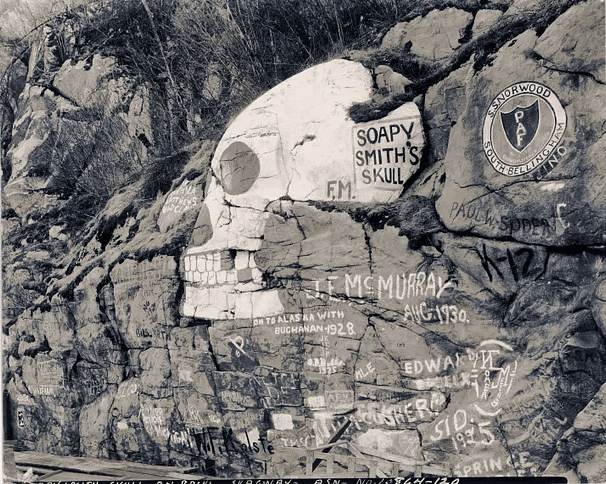
Continue down the dock toward the town, and you’ll soon find yourself standing beneath something completely at odds with the light-hearted, yearbook-like shipping line signatures: Soapy Smith’s skull — a naturally occurring, 25-foot bas-relief formation painted to highlight its unmistakable death’s-head resemblance.
“Soapy Smith’s Skull,” Skagway, Alaska, c. 1931.
As if the painted profile of a grinning skull weren’t memorable enough, the original “artist” included the hand-lettered label “Soapy Smith’s Skull” to tie the feature to an infamous villain from Skagway’s goldrush past. The title united the unique rock formation with one of the town’s longest enduring legends. But Jefferson Randolph “Soapy” Smith was no fictional character — he engaged in confidence schemes and racketeering until his death at age 37 in a Skagway shootout during the height of the Klondike goldrush.
In the decades following Smith’s violent 1898 death on a Skagway dock, early tour operators like Martin Itjen spun tales of Smith’s exploits in Alaska, often embellished, to attract customers to his rapidly growing tour business in the 1920s. As a result of decades-long retellings, Soapy Smith’s reputation is now as comically subtle as a Scooby-Doo villain’s in a Saturday morning cartoon. It’s become difficult to separate the truth of Smith’s life from well-polished fiction.
Because the painted skull first appeared in fall of 1926, it’s been suggested that it was tour operator Itjen himself, or perhaps his associates, who painted the skull as an early tourist attraction, one that could serve as a sort of advertisement for Itjen’s tours and tales. But the skull itself bore a different clue to its origins: the letters “FM”. Were these letters initials? The earliest known photographs show the letters positioned much like an artist’s signature. And, as the skull has been refreshed and repainted over the past hundred years, the letters have been maintained fairly consistently, although no one seems to know what they actually stand for. Like the identity of the artist himself, the letters remain a mystery.
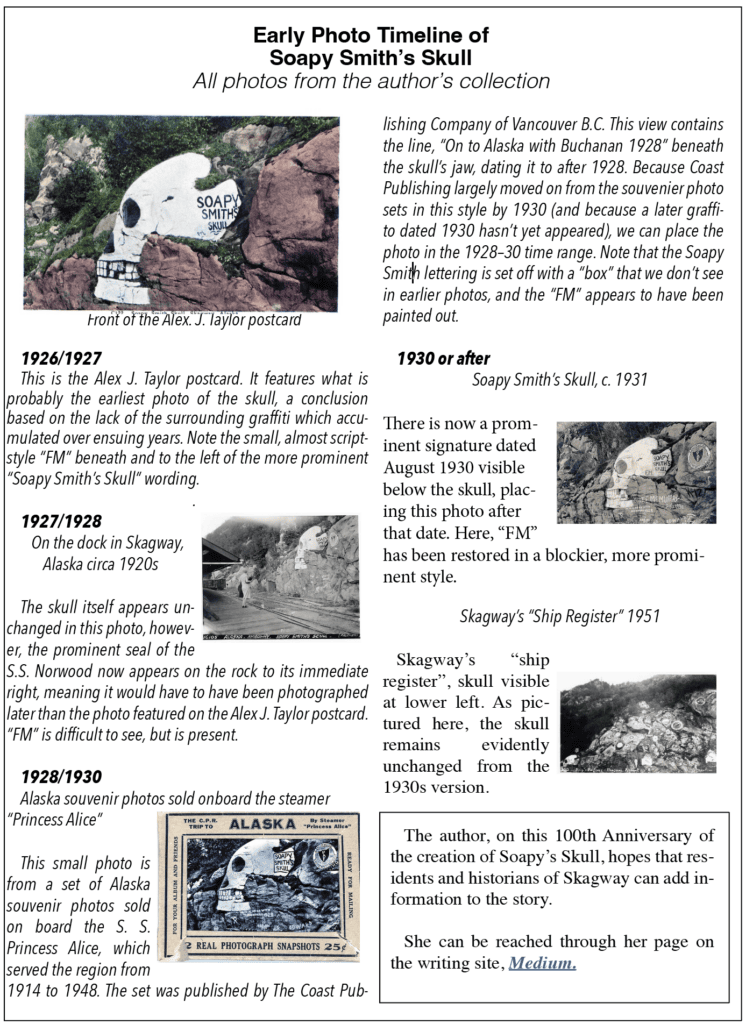
Early photo of the Soapy Smith Skull, undated but taken in the late 1920s. Note that surrounding graffiti is beginning to accumulate. “FM” is difficult to see in this photo but is present.
Like many people who are aware of Soapy Smith’s skull, I first encountered the unique mural on a whirlwind port stop during an Inside Passage cruise. Pausing to take in its leering features during the walk into town, I assumed it was contemporary graffiti. When it was time to return to the ship just a few hours later, my head had been newly filled with the history of the Klondike goldrush, Skagway and Dyea, White Pass, and, yes, melodramatic stories of Jefferson Randolph “Soapy” Smith. Passing the skull on our return to the ship, it occurred to me that the skull’s tie to a historic character might mean that it was older than I’d initially assumed. Cruise itineraries, however, don’t allow much time for contemplation. I set the question of the skull’s origins temporarily aside as our ship departed for the next port.
Later, at home in Washington, I started looking into the skull’s history. Even in the earliest days of the internet, it wasn’t difficult to discover that 1926 was the accepted date of its first appearance. I began tracking online auctions to find early photos of the skull, acquiring a handful of interesting snapshots over the years. Together, they show how the skull was refreshed and occasionally modified (Soapy’s blacked-out teeth seem to come and
go, as an example), even in its early years. It appears the original “FM” was painted over in the very first paint refresh, but almost immediately restored, and in much heavier and obvious script (see photo timeline at the end of this article). Clearly, someone felt that the detail was worth preserving. The signature, if that’s what it is, has been maintained, at least for the most part, ever since.
Then, in 2011 a woman placed an auction listing for a postcard that had come from her grandmother’s collection. It featured the presumed oldest view of the skull — a photograph that had been widely published and was in no way unique. What caught my eye was the written description provided by the seller. In it she claimed the card had been postmarked in 1916 from Cordova, Alaska, fully ten years before the accepted date of the skull’s first appearance. Could this be a careless typo on the part of the seller, or new evidence that the painted skull appeared earlier than previously thought? Her listing, unfortunately, did not include an image of the reverse side of the postcard — the side that included the postmark. I could have reached out to the seller for clarification, but for just a few dollars, I decided to buy the card and examine its postmark for myself.
On arrival, the flip side only complicated the question of its postmark date, but its pencil-written message, worn away in places, may have partially solved an entirely different mystery: Who was “FM” and why was he in Skagway in 1926?
But please, take a look for yourself:
Postcard message written by Alex. J. Taylor claiming to have helped paint Soapy Smith’s skull in summer of 1926.
Yes, it’s in rough condition, but here is a transcript of what I can make out with relative certainty: “Helped F.M. Steward on the … George paint Soapy Smith’s skull in the summer of 1926. Alex. J. Taylor”
That legible portion alone is a remarkably specific claim, but take a look at the partial word that remains in front of the word “George.” I puzzled over that partial word and the blank space preceding it for quite some time. Finally, I realized many of the early cruise ships catering to Alaska tourists had been named after royalty. I wondered if “George” might be part of such a title. The partial word preceding the name certainly looks like it could be the remains of the word “Prince.” And, with a quick online search, I was able to verify that, yes, in fact the S.S. Prince George[1] had cruised the Inside Passage during the time when the Soapy Smith Skull first appeared. The blank space in front of the word “Prince” is probably longer than necessary to accommodate, “S.S.”, but the word “Steamer” might have fit there nicely.
It’s notable that Alex Taylor, the postcard’s author, was not claiming to have been the original painter himself, but that he assisted “F.M.” Unfortunately, he did not clarify if “Steward” was F.M.’s last name or merely the position he held on the ship. F.M. Steward could have signed just his first two initials in order to take credit if the project was well received, or to distance himself if it was instead considered vandalism — after all, nothing other than ship logos and personal slogans had ever appeared in that Skagway location. Either way, if crew lists from the S. S. Prince George remain, it would be instructive to search them for “F.M. Steward” or a steward with the initials F. M.
It’s also unclear if Alex Taylor was also employed on the ship along with FM; however, it makes perfect sense that one or both men, knowing about Skagway’s ship register, helped themselves to the ship’s store of paint so that they could leave their employer’s mark on the rock wall. With buckets and brushes in hand, they may have been inspired to instead paint the skull-like shape in the rocks.
Adjacent to Alex Taylor’s written message, we can see that the postcard was addressed to “Cecil and Sally” at K.I.R.O., a Seattle radio station (which endures today as Seattle’s CBS television affiliate).
Cecil and Sally was a popular radio comedy show produced from 1928 to 1933 for radio station KYA in San Francisco. Recordings of the show were broadcast in the Seattle market in mid-to-late 1934 on KPCB, just as that station was transitioning to new call letters: KIRO. Alex Taylor may have mistaken it for a live broadcast, perhaps unaware that the show had already recorded its last episodes by the time it played in Seattle. He clearly thought it was a good forum in which to claim some bragging rights in regards to the Skagway skull. It also dates the postcard pretty specifically to 1934/1935 or possibly later despite its ambiguous postmark.
Alex Taylor’s postcard invites us to picture the summer of 1926, now a century in the past. Two men, at least one from the S.S. Prince George, stand at the base of a rockface in Skagway, one steadying a ladder while the other applies the final brushstrokes to a grinning skull — pausing to add two careful initials before climbing down, packing up, and slipping back to the ship before anyone takes notice. Whether “FM” ever learned that the result of his impulsive act eventually became one of Skagway’s most memorable landmarks, we may never know. But one hundred years later, an unassuming postcard — mailed to a Seattle radio station and forgotten in a grandmother’s collection for decades — may have finally given us new clues to his identity.
The skull’s centennial feels like the right moment to hand that information to the historians, the archivists, and the Skagway locals who are best positioned to take it from here. If crew manifests from the S.S. Prince George survive, somewhere in them may be the full name behind those two painted letters. “FM” signed his work with initials. It’s time, perhaps, to sign his name in full.
[1] Note that, like many cruise ships of its day, the S.S. Prince George featured white superstructures over a black hull. It would have certainly stocked in an inventory of both black and white paint to touch up damage during sailings — perhaps the same paint used on Soapy Smith’s skull?
region from 1914 to 1948. The set was published by The Coast Publishing Company of Vancouver B.C. This view contains the line, “On to Alaska with Buchanan 1928” beneath the skull’s jaw, dating it to after 1928. Because Coast Publishing largely moved on from the souvenier photo sets in this style by 1930 (and because a later graffito dated 1930 hasn’t yet appeared), we can place the photo in the 1928–30 time range. Note that the Soapy Smith lettering is set off with a “box” that we don’t see in earlier photos, and the “FM” appears to have been painted out.
Comments 0